IdeasThe Real Job of a Program Manager: Translator, Negotiator, and Therapist
Why the Best Program Managers Act as Translators, Negotiators, and Therapists in Modern Organizations
Massimiliano Sermi · · Cooking Agile
programmanagement · leadershipskills · organizationalexcellence
Originally published in Cooking Agile.
Most job descriptions for Program Managers are fiction. They talk about “ensuring delivery,” “driving cross-functional execution,” and “aligning strategy.”
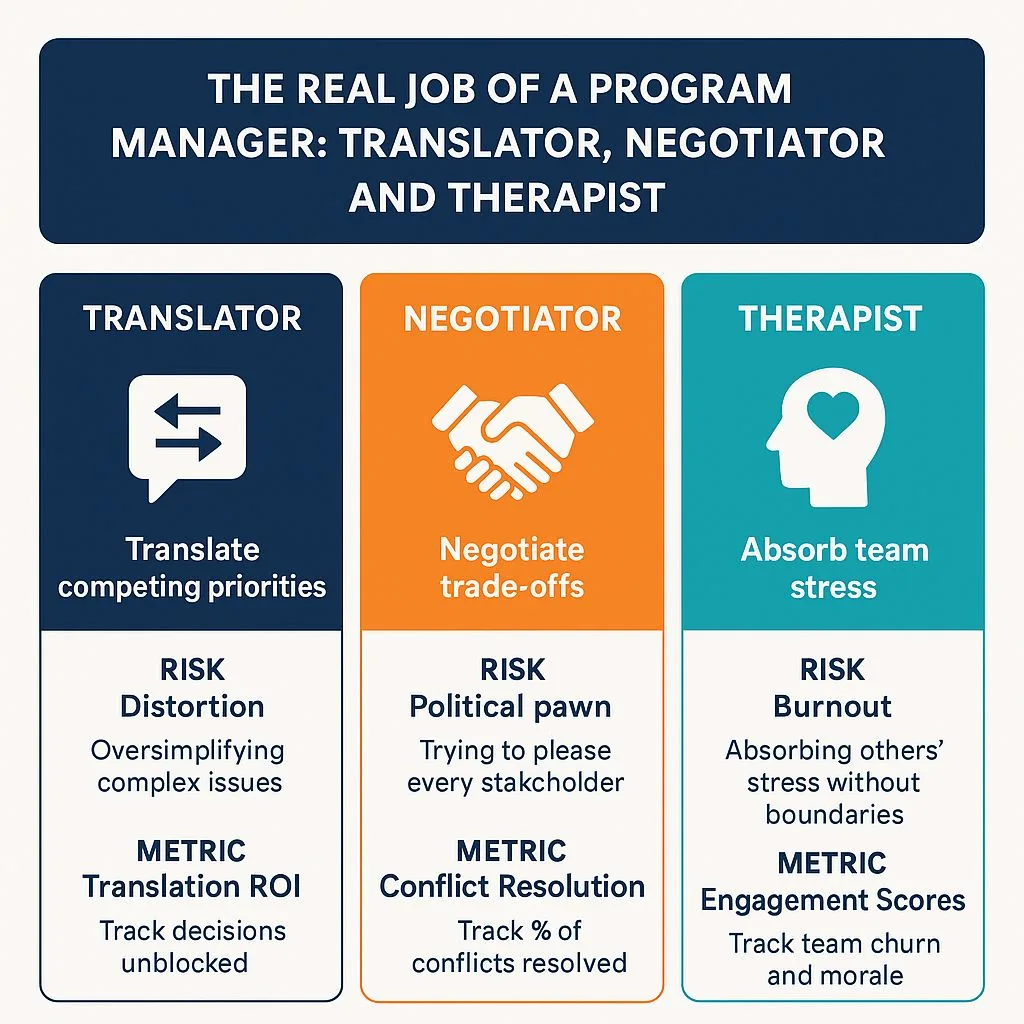
The truth? A Program Manager is less about Gantt charts and more about survival in chaos. The real job is to be a:
Translator of competing priorities
Negotiator of impossible trade-offs
Therapist for teams caught in dysfunction
Here’s what that really means, and how to do it at a level that makes you indispensable.
The Translator
Every function speaks its own language:
Executives: ROI, risk, shareholder value
Engineers: architecture, scalability, velocity
Product: speed to market, user adoption
Ops/Compliance: governance, stability
Finance: costs and forecasts
Without translation, initiatives die in meeting rooms.
👉 Case Study: At a SaaS company, executives asked why engineering was “slow.” Engineers said compliance checks ate 30% of the sprint capacity. The Program Manager translated: “We’re paying a compliance tax equal to €2M/year in lost velocity. Fund automation or accept slower launches.” That reframing got compliance automation funded.
Premium Metric: Translation ROI can be measured by the decisions unblocked. Track how many escalations are avoided because you reframed the problem.
The Negotiator
Program Managers are constantly in resource poker games:
The product wants more engineers.
Security wants mandatory reviews.
Marketing wants earlier launches.
Finance wants cost reductions.
Your job isn’t to decide, it’s to make trade-offs visible and broker compromises.
👉 Case Study: A PMO team wanted to push a Q2 release. Engineering warned of a 30% outage risk without refactoring. The Program Manager negotiated a two-phase plan: refactor in Q2, partial launch in Q3, full launch in Q4. Everyone hated it, which meant it was fair.
Controversial Take: If everyone likes your decision, you’re not negotiating. You’re just relaying.
Premium Metric: Track % of conflicts resolved without exec escalation. That’s your negotiation ROI.
The Therapist
This part rarely shows up in job descriptions, but Program Managers absorb stress:
Engineers vent about constant pivots.
Product Managers complain about exec pressure.
Leaders grumble about the lack of progress.
👉 Case Study: In a fintech scale-up, engineers were demoralised after three pivots in six months. Instead of pushing them harder, the Program Manager scheduled listening sessions. Frustrations were captured, reframed into risks, and escalated as “team health metrics.” Execs finally paused new requests, stabilising morale.
Premium Metric: Track team churn, sick days, or engagement scores. A Program Manager who lowers attrition has saved the company millions.
The Dark Side of Each Archetype
Translator: Risk of distortion → If you oversimplify, you create false expectations.
Negotiator: Risk of becoming political pawn → If you’re too neutral, you lose credibility.
Therapist: Risk of burnout → Absorbing everyone’s stress without boundaries kills your performance.
👉 Premium Playbook Tip: Always document. Translation notes, negotiation outcomes, and even “therapist” summaries should live in a paper trail. Otherwise, you’re invisible.
Comparison Table: Old vs. Modern PM
Role Type | Old-School Project Manager | Program Manager (Real) | Strategic Operator (Next-Level) |
|---|
Focus | Timelines, tasks | Alignment, trade-offs, and team health | Strategy, portfolio ROI |
Tools | Gantt charts, Jira | Stakeholder maps, risk logs | Data dashboards, AI insights |
Perception | Admin role | Glue role | Executive enabler |
Value | On-time delivery | Unblocked execution | Long-term business outcomes |
Future Outlook: Program Manager 2.0 in the AI Era
AI will eat project management. Bots can track Jira tickets, update status reports, and even forecast delays.
But AI can’t:
Translate politics into business language
Negotiate trade-offs between power centres
Absorb emotional frustration and redirect it productively
The moat of the future Program Manager is not administration, it’s translation, negotiation, and therapy. Those are deeply human, context-rich skills.
Premium Toolkit Expansion
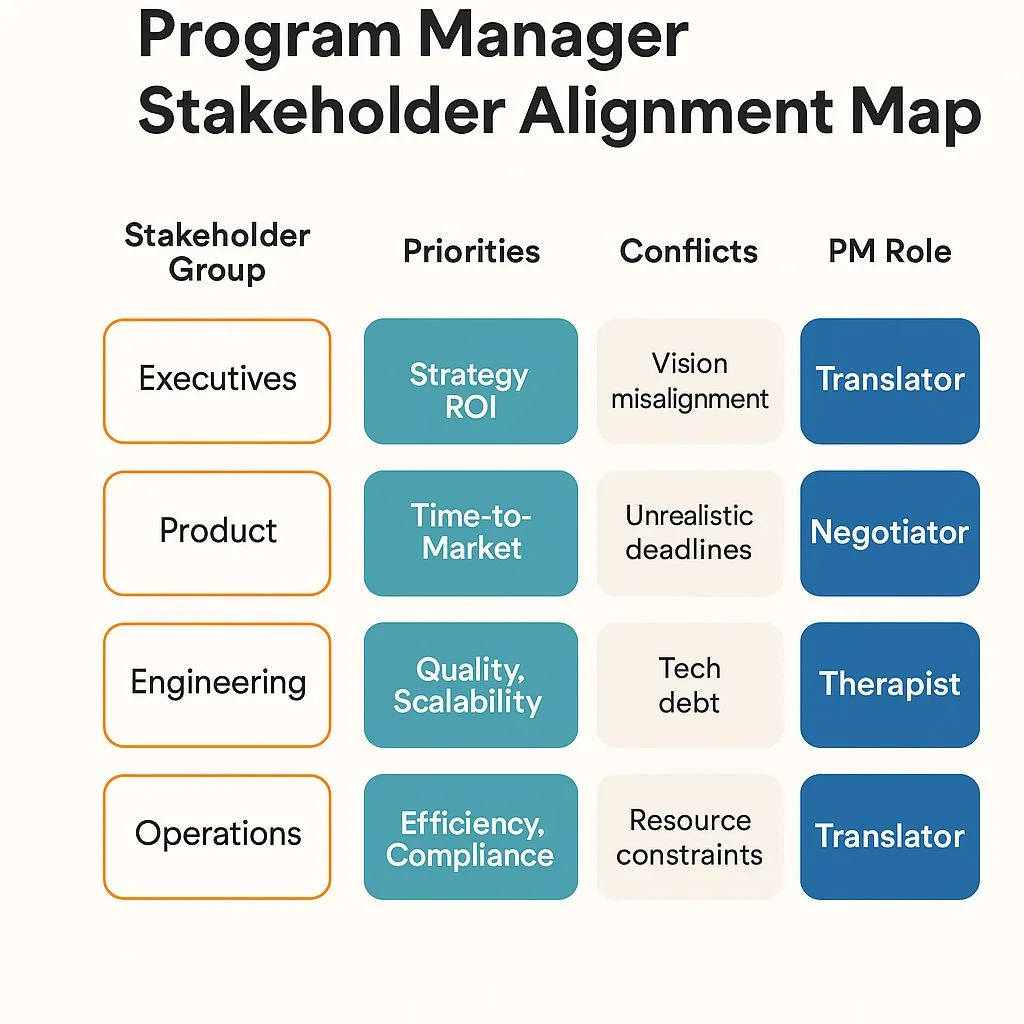
As a subscriber, you already have access to the Stakeholder Alignment Map. Here’s what else is coming in the premium toolkit series:
📑 Conflict Escalation Playbook – Know when to resolve vs. when to escalate.
🧠 Therapist Question Pack – 15 questions to unlock hidden blockers in teams.
🗂 Negotiation Prep Sheet – Frame trade-offs in “if… then…” business terms.
The real job of a Program Manager isn’t in any HR system. It’s in the messy middle of organisations, translating, negotiating, and absorbing.
Do it well, and you’re no longer a Program Manager. You’re a strategic operator — the person who makes the impossible possible.
👉 If you’ve ever felt like a glorified note-taker, this is your roadmap out. Share this article with a fellow Program Manager and invite them to