IdeasThe Influence Architecture Framework
Designing Political Capital, Executive Alignment, and Strategic Visibility
Massimiliano Sermi · · Cooking Agile
strategicleadership · powerandleadership · leadershipinfluence · organizationalstrategy · executivealignment
Originally published in Cooking Agile.
Influence is not charisma.
It is structured.
It is engineered alignment.
In AI & Security environments, influence determines:
Whether governance survives
Whether the risk is escalated
Whether resilience investments are funded
Whether speed is moderated responsibly
Without influence, strategic leaders become advisors.
With influence, they shape direction.
🧠 The 4 Pillars of Influence Architecture
Stakeholder Power Mapping
Political Capital Index
Executive Alignment Blueprint
Strategic Visibility System
Remove one pillar, and influence decays.
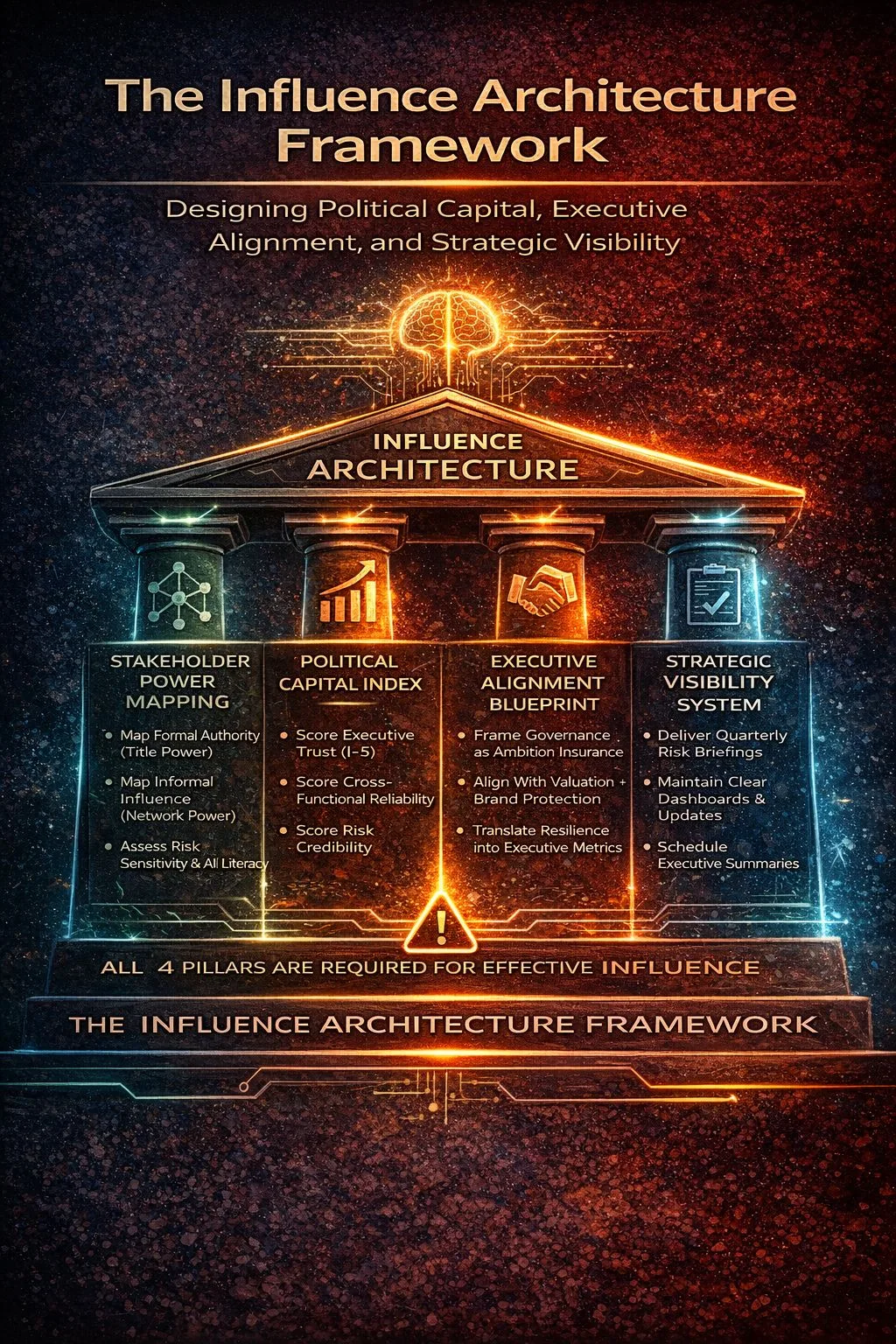
I. Stakeholder Power Mapping
Map Before You Move
Before introducing governance or structural change, classify stakeholders across four dimensions:
Formal Authority (Title Power)
Informal Influence (Network Power)
Risk Sensitivity (Defensive vs Growth-Oriented)
AI Literacy (High / Medium / Low)
Create a simple 2x2 grid:
High Influence / High Risk Sensitivity → Natural Allies
High Influence / Low Risk Sensitivity → Strategic Education Required
Low Influence / High Risk Sensitivity → Coalition Builders
Low Influence / Low Risk Sensitivity → Noise
Do not propose structural governance changes without this map.
That is an amateur strategy.
The Stakeholder Mapping Engine converts influence from intuition into structured power analysis.
This makes your Influence OS practical — not theoretical.
What’s Inside
Formal Authority scoring (1–5)
Informal Influence scoring (1–5)
Risk Sensitivity level
AI Literacy level
Governance Alignment classification
Engagement Strategy tracking
Executive Sponsor flag
Automatic Influence Power Index (Authority × Influence
II. Political Capital Index
Political capital is stored credibility.
It increases when you:
Deliver measurable outcomes
Protect the organisation from risk
Communicate clearly
Support cross-functional wins
It decreases when you:
Score yourself (1–5) across:
If your average is below 3.5, build capital before pushing governance reform.
The Political Capital Index transforms influence from intuition into measurable leverage.
It allows leaders to:
Diagnose influence strength
Identify the weakest dimension
Track improvement quarterly
Build governance authority intentionally
What This Tool Measures
It quantifies influence across 6 structural dimensions:
Executive Trust
Cross-Functional Reliability
Risk Credibility
Strategic Communication
Delivery Track Record
Influence Visibility
It automatically calculates:
III. Executive Alignment Blueprint
Governance must align with executive incentives.
Frame AI governance not as:
“Risk control.”
But as:
Valuation protection
Regulatory foresight
Brand preservation
Long-term scalability
Translate governance into language executives reward.
This is strategic framing.
IV. Strategic Visibility System
Influence requires visibility.
Not noise.
Strategic visibility includes:
If leadership only hears about AI when something breaks, governance will be blamed.
Visibility preconditions trust.
🔐 The Influence Timing Model
Never introduce structural governance during:
Introduce it when:
Risk events in the industry occur
Regulatory headlines dominate
Competitive incidents highlight exposure
Timing multiplies influence.
📊 Integrating Into Your Strategic Leadership OS
Inside your Influence Database, add:
Political Capital Score (1–5)
Executive Sponsor Identified? (Checkbox)
Alignment Framing Documented? (Checkbox)
Strategic Briefing Scheduled? (Date)
Create filtered view:
🔎 High Risk Initiative / No Executive Sponsor
This view shows where governance will fail politically.
⚠ The Strategic Truth
Influence is not manipulation.
It is system alignment.
It is translating risk into strategic advantage.
In the AI & Security Era:
Technical clarity without influence equals stagnation.
Influence without structure equals chaos.
Strategic leadership requires both.
🚀 Next Module
We transition into:
Career Compounding Architecture
→ How to position yourself as a strategic AI & Security leader
→ Building long-term leverage
→ Designing optionality
Because systems shape organisations.
But positioning shapes careers.