IdeasThe Governance ROI Framework
How to Quantify the Economic Value of Oversight
Massimiliano Sermi · · Cooking Agile
riskmanagement · enterprisevalue · corporategovernance · executiveleadership · capitalefficiency
Originally published in Cooking Agile.
In the free article, we established:
Governance protects valuation.
Now we answer the harder question:
How do you measure it?
Because executives fund what they can quantify.
Step 1 — Understand the Real Cost of Governance Failure
Governance failure has four cost layers:
1️⃣ Direct Financial Loss
Regulatory fines
Litigation costs
Remediation expenses
Operational downtime
2️⃣ Revenue Disruption
Customer churn
Sales freeze
Delayed deals
Contract cancellations
3️⃣ Reputational Damage
4️⃣ Capital Market Impact
Most leaders only calculate layer one.
The economic impact lives in layers three and four.
Step 2 — The Governance ROI Formula
We define:
Expected Risk Cost (ERC)
ERC = Probability of Incident × Total Impact Cost
Total Impact Cost =
Direct Loss + Revenue Impact + Reputation Impact + Capital Impact
Governance reduces:
Therefore:
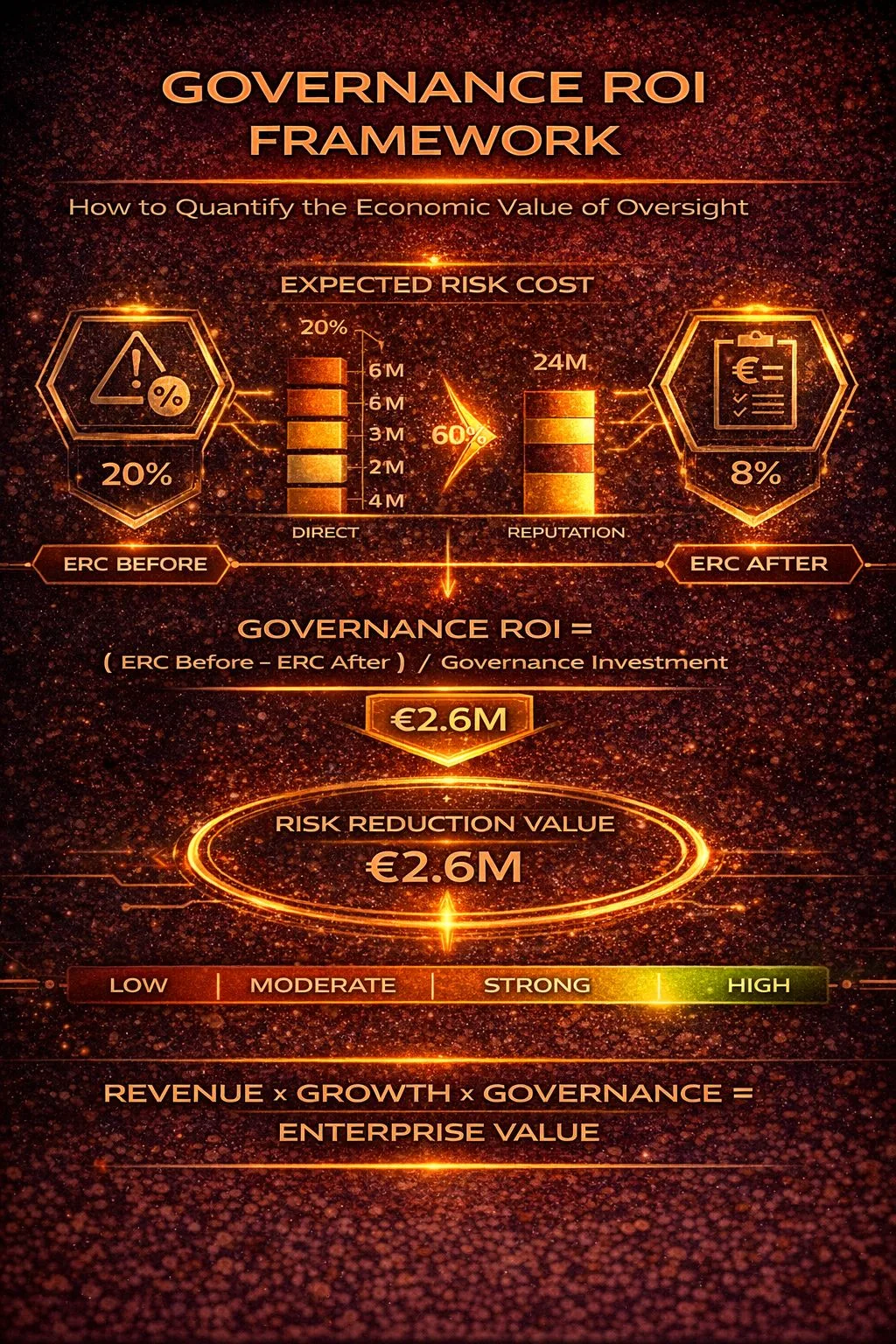
Governance ROI = (ERC before governance − ERC after governance) / Governance Investment
This is economic logic.
Step 3 — Estimating Probability Reduction
You don’t need perfect math.
You need directional modelling.
Example:
Without structured AI oversight:
Estimated 3-year probability of regulatory event = 20%
With structured governance:
Estimated probability = 8%
That delta has monetary value.
Step 4 — Modelling Impact Magnitude
Estimate potential impact:
Example AI compliance failure:
Total Impact = €22M
Probability shift from 20% to 8%:
ERC before = 0.20 × 22M = 4.4M
ERC after = 0.08 × 22M = 1.76M
Risk reduction value = €2.64M
If governance investment = €800k
ROI = 2.64M / 800k = 3.3x
Now governance is an investment, not a cost.
Step 5 — The Governance ROI Dashboard
You should track:
This turns abstract risk into board-level language.
Step 6 — Valuation Multiple Protection
Public market price:
Uncertainty.
Strong governance reduces volatility.
Reduced volatility lowers the risk premium.
Lower risk premium increases valuation multiple.
This effect compounds.
You rarely see it in quarterly reports.
But it shapes long-term capital efficiency.
The Leadership Advantage
Most leaders speak in:
Policies.
Few speak in:
Risk-adjusted value.
When you frame governance as capital efficiency,
You change the conversation.
What This Means for You
If you want executive support:
Don’t ask for:
“More oversight.”
Present:
“Risk-adjusted valuation protection of €X million.”
Boards understand capital logic.
Included With This Article
You now get:
✔ Governance ROI Calculator (Excel)
✔ Risk Probability Estimation Template
✔ Impact Modelling Sheet
✔ Executive Briefing Format
Because strategic leadership is not theoretical.
It is quantitative.
Next:
We return to FREE with:
Decision Latency vs Decision Quality
Why Fast Leaders Build Fragile Systems