IdeasThe Decision Architecture Framework
Designing Escalation Logic in an AI & Cyber Risk Environment
Massimiliano Sermi · · Cooking Agile
strategicleadership · aigovernance · riskmanagement · cybersecuritystrategy · organizationalresilience · decisionarchitecture · digitaltransformation
Originally published in Cooking Agile.
In the free edition, we explored why leaders fail under uncertainty.
Now we move from awareness to architecture.
Because the problem is not bad leaders.
The problem is unstructured decision systems.
In the AI & Security Era, decision quality must be engineered.
🧠 Why Architecture Matters
Most organisations rely on:
Intuition
Experience
Authority hierarchy
That worked when:
Today:
Unstructured decisions become systemic vulnerabilities.
🏗 The Decision Architecture Framework
This framework defines:
Which decisions require escalation
Which decisions must slow down
Which decisions can move fast
Who must be involved
When irreversibility overrides speed
Layer 1 — Decision Classification
Every strategic decision must be classified across three axes:
1️⃣ Reversibility
Type 1: Irreversible (Data exposure, regulatory breaches, brand damage)
Type 2: Costly to Reverse (Architecture changes, AI deployments)
Type 3: Easily Reversible (UI tests, internal tooling tweaks)
Only Type 3 decisions should move fast without escalation.
Most organisations treat Types 2 and 1 as Type 3.
That’s the fragility point.
2️⃣ Risk Surface Expansion
Ask:
Does this increase the attack surface?
Does this centralise sensitive data?
Does this create regulatory exposure?
Does this automate risk?
If yes → escalation is mandatory.
3️⃣ Systemic Amplification
AI and automation amplify decisions.
Ask:
If this scales 10x, what breaks?
If this fails publicly, what happens?
If this model behaves unexpectedly, who is accountable?
If amplification risk exists → structured oversight is required.
🧭 The Escalation Matrix
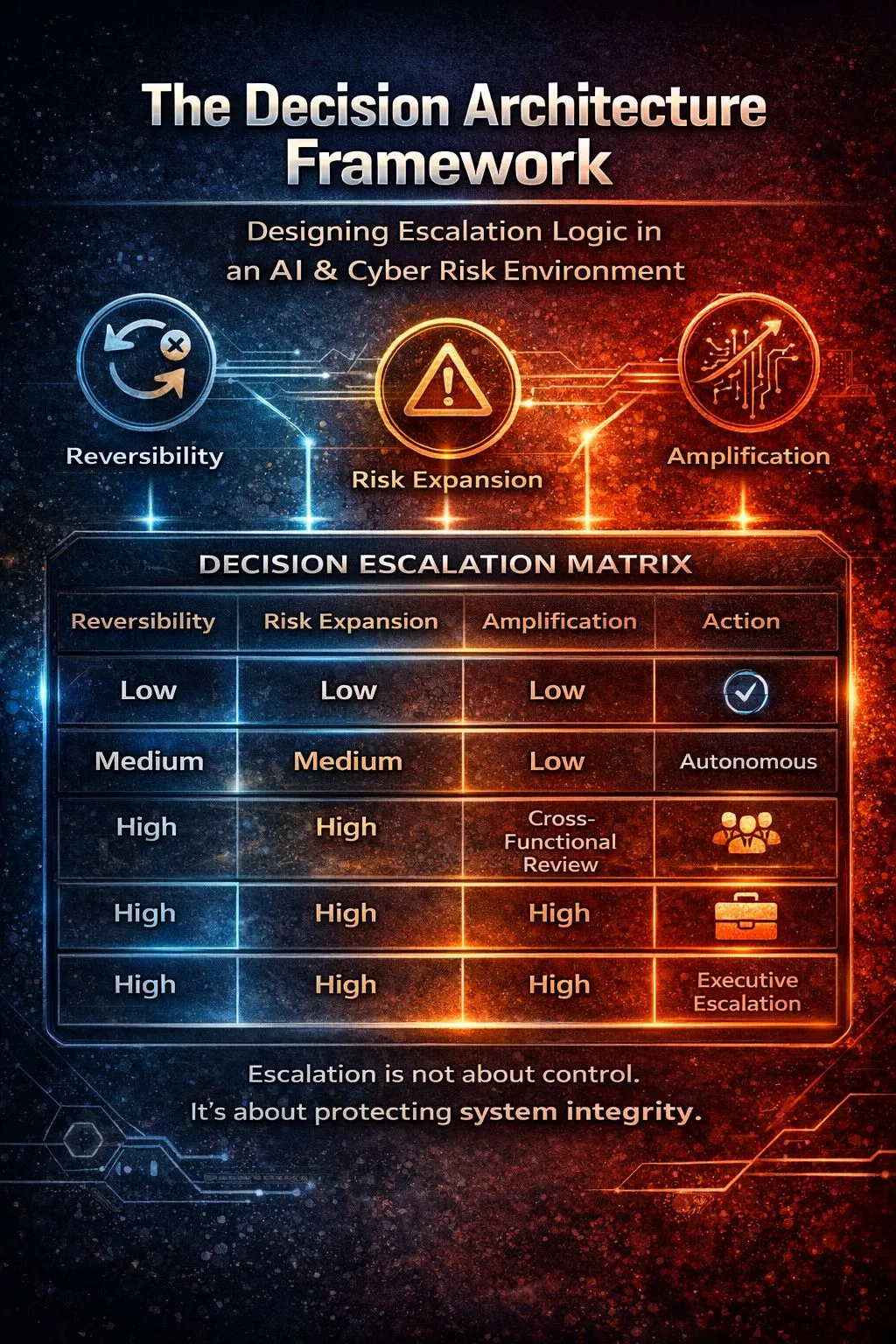
You can implement this in your Notion OS.
Reversibility | Risk Expansion | Amplification | Action |
|---|
Low | Low | Low | Autonomous |
Medium | Medium | Low | Manager Review |
High | Medium | Medium | Cross-Functional Review |
High | High | High | Executive Escalation |
Escalation is not about control.
It’s about protecting system integrity.
⚖ When to Slow Down Intentionally
Speed is seductive.
But intentional slowdown is strategic.
You slow down when:
The decision is irreversible
Risk surface expands
External exposure increases
AI system lacks auditability
Strategic leaders know when friction protects value.
🧠 Designing Irreversible Decision Protocols
For Type 1 decisions, implement:
Written risk articulation
Cross-domain review (Security + Legal + Product)
Formal sign-off
Post-decision review checkpoint
This creates institutional memory.
Most companies skip this.
That’s why they repeat mistakes.
🚨 The Hidden Leadership Trap
Many leaders avoid escalation because:
It feels political
It feels slow
It feels bureaucratic
But structured escalation is not a weakness.
It is strategic maturity.
In the AI era:
Control > Speed.
🔬 Practical Implementation Sprint (This Week)
Classify 3 active decisions by reversibility.
Identify 1 initiative increasing risk surface.
Build a mini escalation matrix for your team.
Define one decision type that now requires cross-review.
This is your first architectural upgrade.
🔐 Why This Framework Matters
AI increases amplification.
Cyber risk increases exposure.
Regulation increases accountability.
Unstructured decisions increase fragility.
The leaders who win in this era will not be the fastest.
They will be the most structurally disciplined.
The Decision Escalation Engine is now embedded in the Strategic Leadership OS Notion Template.
It forces discipline in environments where speed hides risk.
That’s not content.
That’s a competitive advantage.
Next Module:
We move into Resilience Architecture
Designing systems that survive failure by default.