IdeasThe AI Governance Framework
Designing Oversight, Accountability, and Control in AI-Driven Organizations
Massimiliano Sermi · · Cooking Agile
strategicleadership · aigovernance · digitalgovernance · enterpriserisk · boardoversight · executiveleadership
Originally published in Cooking Agile.
Most organisations are scaling AI.
Very few are in control.
AI governance is not a compliance checklist.
It is an architectural discipline.
If AI amplifies decisions, governance must structure amplification.
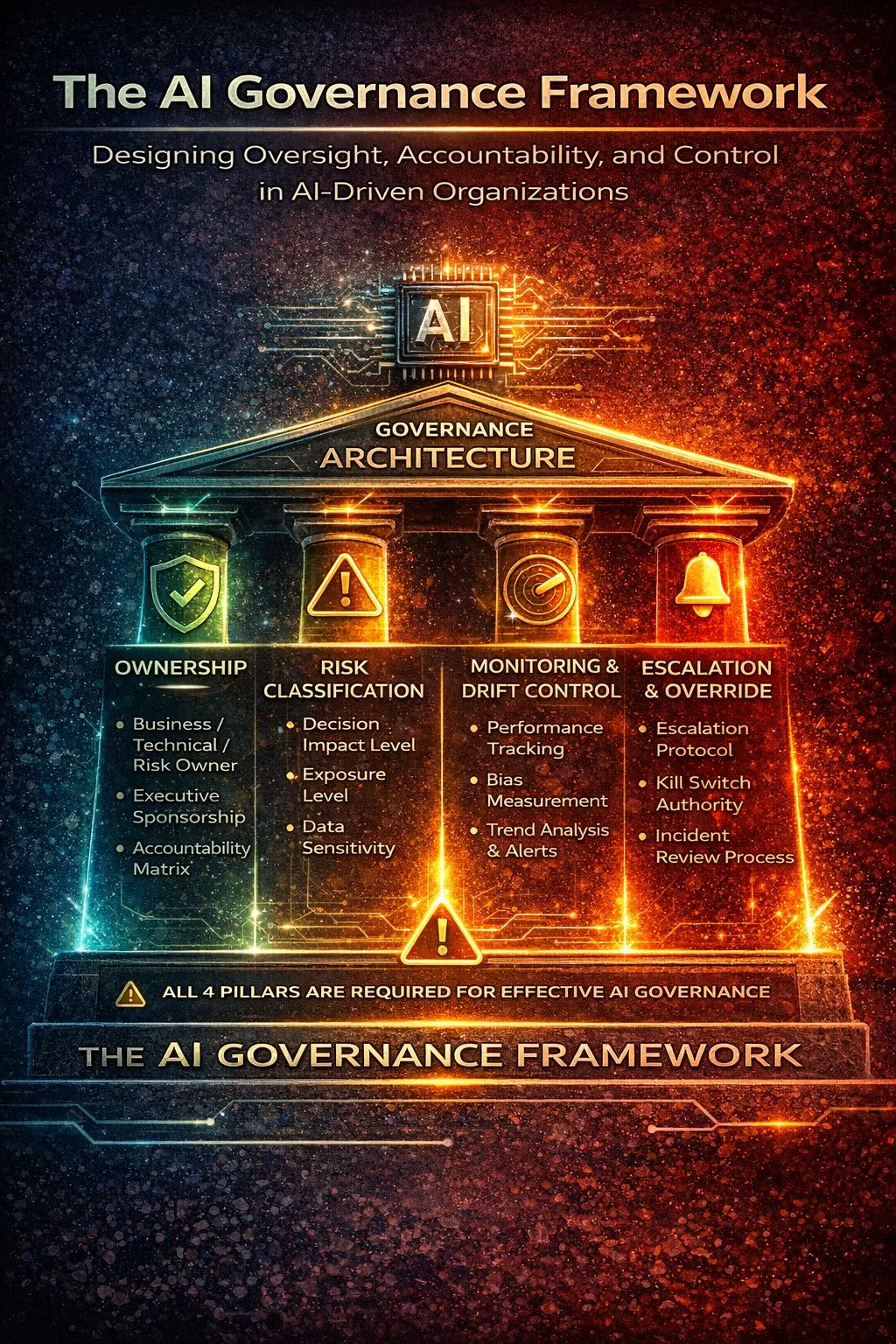
🧠 The AI Governance Architecture
Effective AI governance has 4 pillars:
Ownership
Risk Classification
Monitoring & Drift Control
Escalation & Override
Remove one pillar, and governance collapses.
I. Ownership Architecture
Who Owns the Outcome?
AI governance fails first at accountability.
Define clearly:
Business Owner (Why does this exist?)
Technical Owner (How does it function?)
Risk Owner (What could go wrong?)
Executive Sponsor (Who absorbs reputational impact?)
If ownership is fragmented, risk is diffused.
And diffused risk becomes invisible risk.
II. AI Risk Classification Model
Not all AI initiatives are equal.
Classify each AI system by:
1️⃣ Decision Impact Level
Informational (assists humans)
Advisory (recommends actions)
Autonomous (executes actions)
2️⃣ Exposure Level
3️⃣ Data Sensitivity
AI Risk Tier Output
Combine these dimensions to create:
This must be documented.
Not assumed.
III. Monitoring & Drift Control
AI systems decay over time.
Governance requires:
If monitoring is not real-time, governance is cosmetic.
IV. Escalation & Human Override
Every AI system must define:
If an AI system cannot be paused quickly, it is a liability.
🔐 AI Governance Review Cadence
Establish review rhythm:
Monthly performance review (technical)
Quarterly risk reassessment (cross-functional)
Biannual executive AI risk briefing
Annual stress simulation
Governance is a rhythm.
Not a document.
📊 Integrating into Your Strategic Leadership OS
Inside your Notion AI Strategy Database, add:
AI Risk Tier (Select: Tier 1 / 2 / 3)
Executive Sponsor (Person)
Drift Monitoring Active? (Checkbox)
Bias Testing Active? (Checkbox)
Kill Switch Defined? (Checkbox)
Last Governance Review (Date)
Create filtered view:
🔎 High Risk & Weak Oversight
Filter:
That view reveals exposure instantly.
What’s Included
Clear ownership structure (Business / Technical / Risk Owner)
AI Risk Tier classification (1–3)
Decision impact + exposure + data sensitivity fields
Bias / Security / Regulatory / Reputational risk scoring
Automatic overall risk score calculation
Governance controls tracking:
Drift monitoring
Kill switch
Escalation path
Review cadence/
⚠ The Leadership Trap
Many leaders assume AI governance slows innovation.
The opposite is true.
Clear governance accelerates safe scaling.
Unclear governance slows everything once a crisis hits.
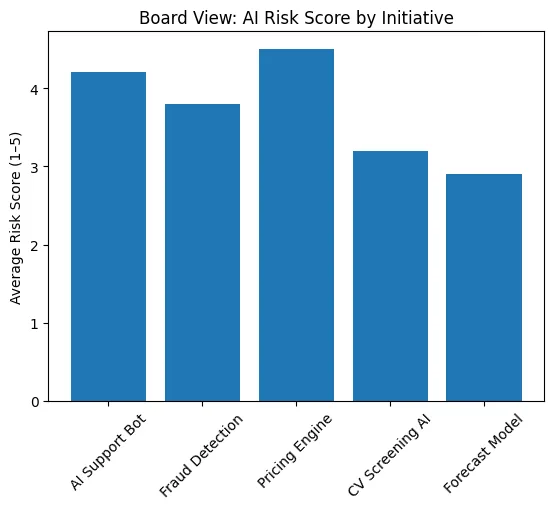
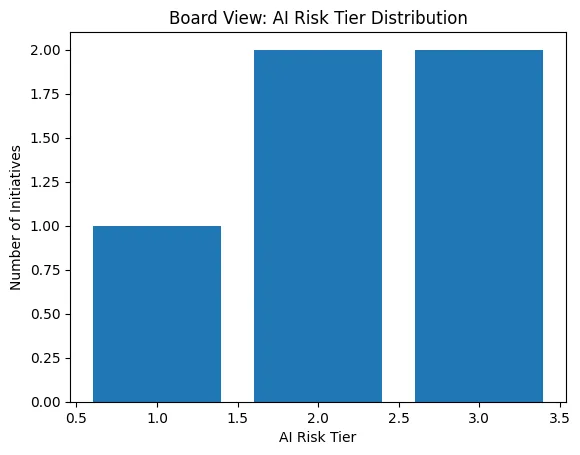
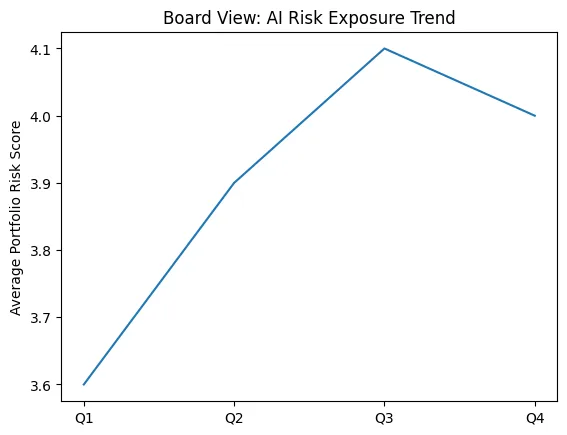
The Board-Level AI Oversight Dashboard converts AI from an innovation narrative into a measurable governance portfolio.
It allows boards and executives to see:
Which AI initiatives carry the highest exposure
How risk is distributed across tiers
Whether overall AI exposure is increasing or stabilizing
Where executive intervention is required
🧭 Implementation Sprint
This week:
Identify 1 AI initiative.
Assign explicit Business + Risk Owner.
Classify it into Tier 1 / 2 / 3.
Define kill switch authority.
Schedule the first governance review.
That’s the beginning of structural control.
🚀 Next Module
We transition into:
Influence Architecture
→ How strategic leaders gain authority to enforce governance
→ Navigating politics around AI control
→ Building executive trust
Because governance without influence fails.