IdeasGo-To-Market Strategy 101: From Idea to Revenue in 5 Steps
Go-To-Market Strategy 101: A Step-by-Step Playbook to Turn Ideas into Revenue
Massimiliano Sermi · · Cooking Agile
productstrategy · businessgrowth · gotomarket
Originally published in Cooking Agile.
Most teams treat Go-To-Market (GTM) as a marketing exercise. They build 50-slide decks full of buzzwords, then wonder why sales don’t move.
The truth? GTM isn’t about pretty slides; it’s about clear decisions that take an idea to revenue. In this playbook, I’ll walk you through the 5 steps of an effective GTM strategy, expanded with case studies, pitfalls to avoid, benchmarks, and iteration cycles.
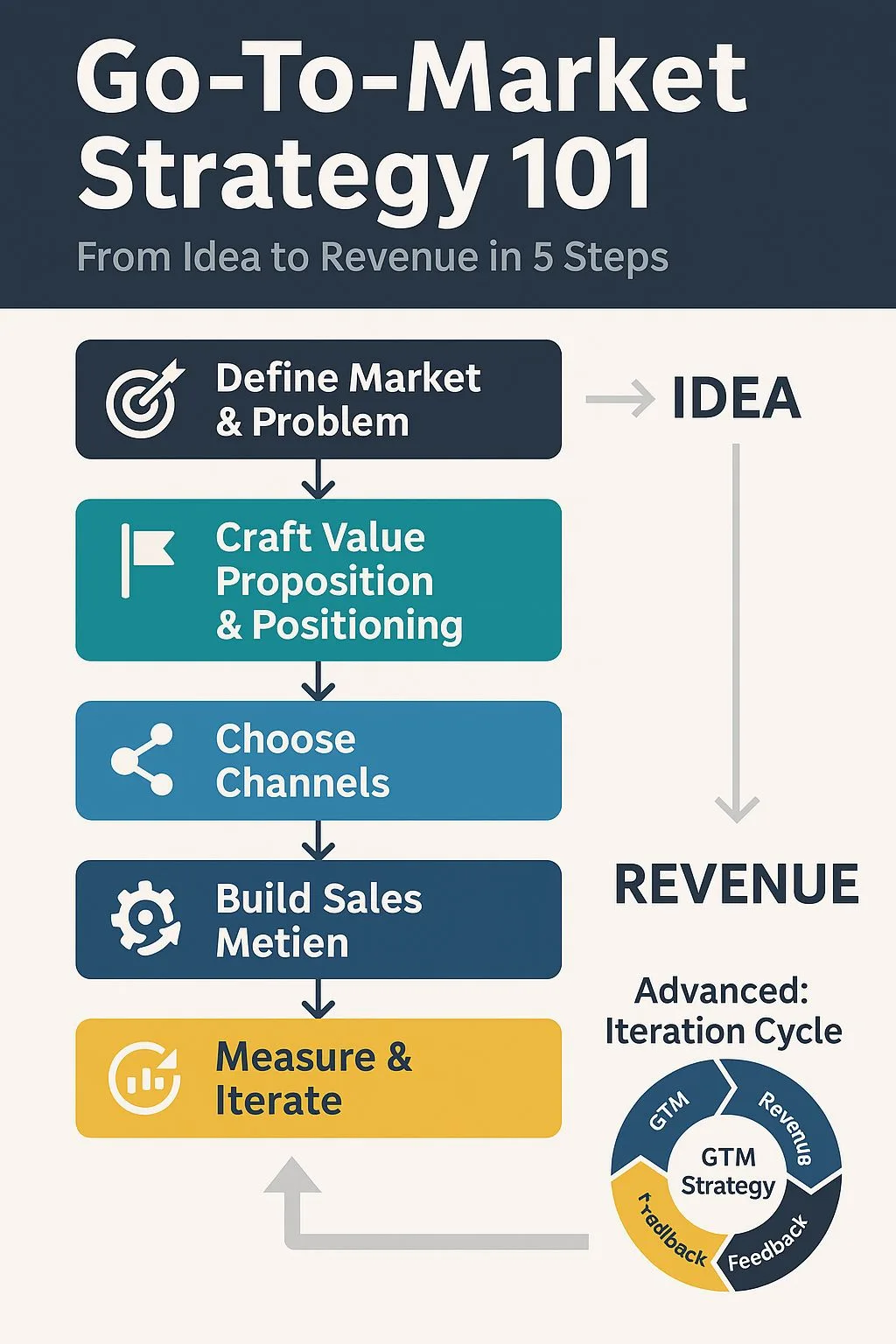
Step 1: Define Your Market & Problem
Don’t start with features. Start with who and why.
Who exactly is your customer?
What problem are they desperate to solve?
Why now? (timing is everything)
👉 Case Study (SaaS): A B2B SaaS product targeting “mid-size companies” struggled with a 9-month sales cycle. After niching down to “HR teams in 200–1000 employee companies with high turnover,” sales cycles shortened to 5 months, and the win rate improved from 18% to 33%.
Step 2: Craft Your Value Proposition & Positioning
Your value prop should fit in 20 words or fewer.
Example:
❌ “We are a holistic AI-powered workforce optimisation solution.”
✅ “We help HR teams reduce turnover by 30% in 90 days.”
Hot take: If your value prop needs a paragraph, you don’t have one.
Step 3: Choose Your Channels (Less is More)
Most teams spread themselves across 10 channels. That’s a mistake.
Pick 2–3 core channels and go deep.
SaaS → LinkedIn + content marketing + SDRs
Consumer → TikTok + Instagram ads
B2B enterprise → Events + outbound sales + analyst relations
👉 Case Study (Consumer): A DTC brand cut Facebook ad spend by 70% and doubled down on TikTok micro-influencers. CAC dropped from $80 to $40, while revenue grew 3x in 6 months.
Step 4: Build a Repeatable Sales Motion
GTM is not a “launch moment.” It’s a machine.
Define lead stages (MQL → SQL → Opp → Closed Won).
Align marketing + sales handoffs.
Standardise discovery call scripts and decks.
If your sales deck looks different in every call, you don’t have a GTM strategy, you have chaos.
👉 Case Study (Enterprise B2B): A cybersecurity startup realised reps were each running their own sales process. After standardising messaging and setting up a CRM-based pipeline, the win rate jumped from 12% to 28%.
Step 5: Measure, Learn, and Iterate
Forget vanity metrics. Focus on what proves GTM success:
👉 Case Study (B2B Enterprise): A SaaS company discovered its CAC payback was 18 months, far above investor tolerance. By tightening ICP and refining outbound scripts, they brought it down to 9 months, unlocking Series B funding.
Benchmarks to keep in mind:
SaaS CAC payback: <12 months healthy, 6–9 months excellent.
B2B Enterprise win rate: 25–35% is competitive.
Retention: Day 30 = 40%+, Day 90 = 25%+ signals traction.
5 Common GTM Mistakes That Kill Launches
Vague ICP → “Our target is everyone” = death sentence.
Too many channels → Spreads team thin, no channel dominates.
Buzzword soup → “AI-powered, cloud-native, holistic…” = meaningless.
No sales enablement → Sales reps are improvising leads to chaos.
Ignoring retention → A flashy launch with 80% churn is still a failure.
Cross-Functional Alignment: Who Owns GTM?
Product → Defines ICP, value proposition, and roadmap alignment.
Marketing → Builds awareness, campaigns, and inbound leads.
Sales → Executes the sales motion, provides frontline feedback.
Engineering → Ensures readiness, demos, and technical support.
Customer Success → Drives retention and expansion.
Finance → Validates pricing models and payback periods.
👉 Without alignment, GTM becomes siloed, and customers experience friction at every handoff.
Advanced Layer: The Iteration Cycle
GTM isn’t one-and-done. It’s a loop:
Idea → GTM Strategy → Revenue → Feedback → Refined GTM.
Each quarter, revisit your GTM Canvas and update based on what you’ve learned:
Did CAC improve or worsen?
Did retention hit benchmarks?
Which channel delivered the best ROI?
Iteration is the difference between a launch event and a growth engine.
Premium Toolkit
📑 GTM Canvas (PDF Template) – map your 5 steps in one page.
📊 Metrics Dashboard (Excel) – track CAC, LTV, funnel conversion, and retention.
🗂 Case Study Pack – expanded SaaS, consumer, and B2B case studies with detailed numbers.
A GTM strategy isn’t a deck. It’s a set of decisions and repeatable processes that take your idea to revenue.
Do it right, and you’re not just launching, you’re building a growth engine.