Ideas🪞 Agile Isn’t a Framework—It’s a Mirror
What your Agile transformation really says about your company
Massimiliano Sermi · · Cooking Agile
productmanagement · workplaceculture · organizationalchange · agiletransformation · agileleadership
Originally published in Cooking Agile.
“Agile doesn’t fail because of Jira boards or sprint rituals. It fails because it reveals more than most companies are willing to confront.”
🔍 Introduction: The Uncomfortable Truth of Agile
Agile isn’t a toolkit. It’s not Scrum or Kanban.
It’s a systemic reflection tool—one that exposes your team’s operating system and leadership culture.
When implemented with intention, Agile shows:
That’s why most Agile transformations don’t fail by accident—they fail by design.
🔄 The 4 Mirrors of Agile: Where Is Your Team?
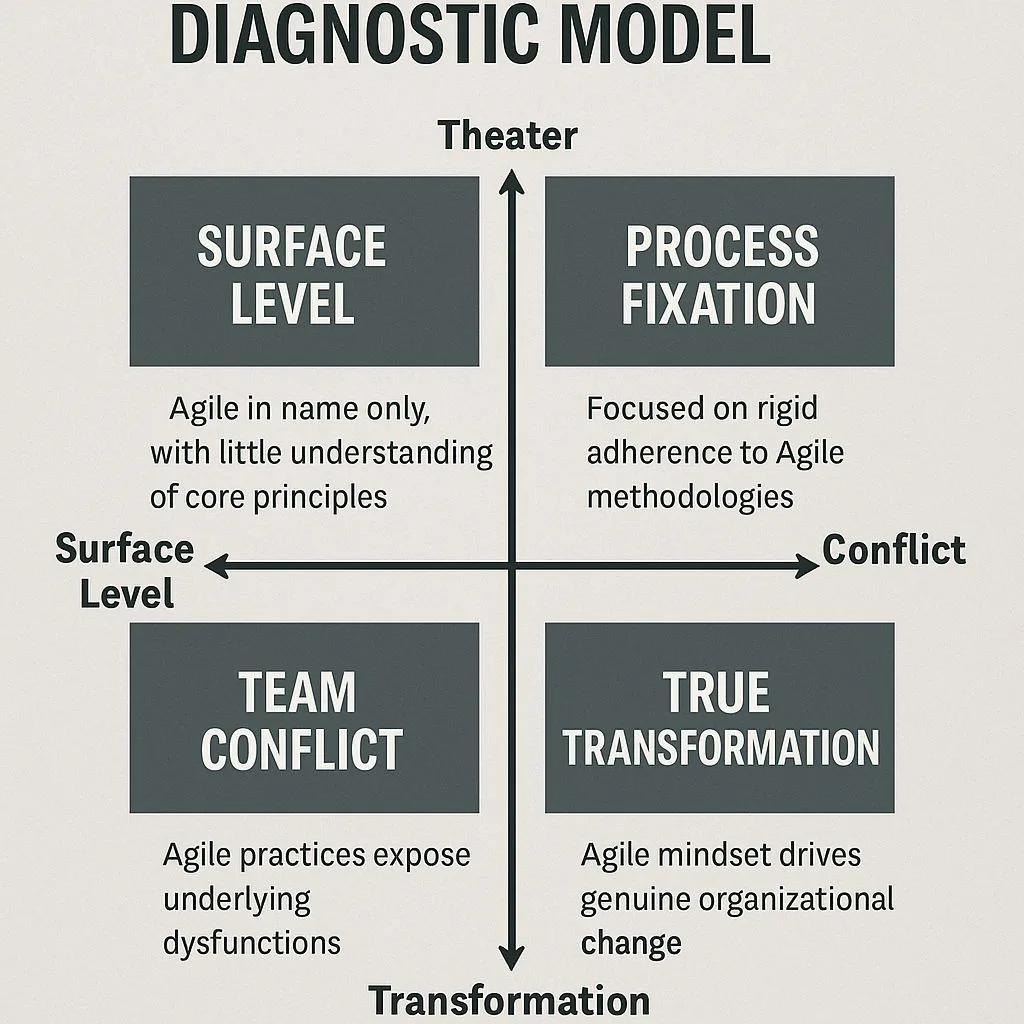
Here’s how to diagnose your Agile reality using the Agile Mirror Diagnostic Model:
📊 Download the Agile Mirror Diagnostic Infographic
Quadrant | Description |
|---|
Surface Level | Agile in name only. Stand-ups are status reports. Retros are routine. There’s no understanding of the why. |
Process Fixation | Rigid process adherence: "We follow Scrum perfectly"—but still don’t deliver value or adapt. |
Team Conflict | Agile starts surfacing deep team dysfunctions. Communication breakdowns, trust issues, siloed work emerge. |
True Transformation | Teams use Agile to reflect, iterate, and evolve continuously. Leaders empower, not control. Growth mindset prevails. |
🧠 The Psychology Behind Agile Resistance
When teams resist Agile, what they’re really resisting is change that exposes ego and control. Here are the internal forces at play:
Status Quo Bias – Preferring "how we’ve always done it"
Authority Bias – Blindly following top-down mandates
Fear of Accountability – Agile demands ownership, not excuses
Cognitive Dissonance – “We’re Agile” vs. “We don’t iterate, listen, or improve”
💣 Why Agile Transformations Fail (And What to Do Instead)
Most Agile efforts fail because they try to fix the process—without fixing the people.
Common Failure | Root Cause | Fix |
|---|
“Agile doesn’t work here” | Cultural resistance | Leadership coaching |
“We do stand-ups but nothing changes” | Agile theater | Purposeful retrospectives |
“Our teams don’t own outcomes” | Top-down decision-making | Empower teams with decision rights |
❓ Premium FAQ: Real Questions, Honest Answers
1. What if my boss is the problem?
You can’t coach someone who doesn’t want to change. But you can influence. Start by bringing visibility to blockers with data (missed deadlines, rework, bugs) and suggest Agile as a tool for continuous improvement—not rebellion.
2. We’re doing Scrum but not seeing results. What gives?
Scrum ≠ agility. Results come from collaboration, user feedback, and adaptive planning—not rituals alone.
3. Our culture is toxic. Is Agile even possible here?
Yes—but only if you're willing to start small. Focus on one pilot team, create a pocket of psychological safety, and prove that Agile works when trust is present.
4. How do I convince leadership to go deeper into Agile?
Speak in their language: risk mitigation, speed to market, customer retention, cost of delay. Tie Agile practices to measurable outcomes.
✅ Action Toolkit
📥 Agile Maturity Self-Assessment PDF
A 10-question diagnostic for teams to score their maturity across autonomy, feedback loops, safety, and delivery.
🖼️ Agile Mirror Diagnostic Model (Infographic)
Visually map where your team falls—and where you need to move.
💬 Leadership Coaching Prompts
“What’s one process we follow that no longer serves us?”
“Where do we pretend to be Agile, but aren’t?”
“What’s the cost of not improving right now?”
🔥 Bottom Line: Agile Isn’t Easy—It’s Worth It
You don’t adopt Agile to feel safe. You adopt it to get better.
Agile, when practised with integrity, becomes a mirror that shows:
How teams work when no one’s watching
How leaders behave under pressure
How systems break—and how to rebuild them
Most teams don’t need more frameworks.
They need the courage to face the truth—and iterate from there.
This kind of transformation-focused insight is why we created The Chef’s Table — our premium newsletter for builders, thinkers, and leaders.